Categories
Calendars
Guides
Reviews
Archive
Gallery
Articles
Ask Our Gardening Expert
Poinsettia the Christmas Plant. How to grow, care and cultivate them.
Article by Jay Fillimore
Poinsettia, the Christmas plant, is popular in many
American, Australian and UK homes. With the introduction of long-lasting cultivars, the
popularity of the poinsettia has increased significantly.
About Poinsettias
Watering A wilted Poinsettia plant may drop its leaves prematurely, so check the soil
frequently. Plants exposed to high light and low humidity require
more frequent watering. If wilting does occur, immediately water
and 5 minutes later water again.
Temperature
Make Your Poinsettia Flower Next Year? Name: jim@GardenAction Name: Dana Name: jim@GardenAction Name: Emma Name: jim@GardenAction Name: Rhys Name: jim@GardenAction Name: Elaine Hill Name: jim@GardenAction Name: George Name: elaine sharp Name: Elizabeth Walters Name: cath oliver Name: Marilyn Evans Name: andy maharaj Name: Annette Name: Annette Name: Wendy Turner Name: Aimee-jo Name: Nazia
Poinsettias

Joel
Robert Poinsett, first U. S. ambassador to Mexico who obtained
plants from the wilds of southern Mexico, introduced it to the
United States in 1825. The common name for the exotic plant,
poinsettia, came from his last name. Botanically, the plant is
known as Euphorbia pulcherrima.
Examine the soil daily, and when the surface is dry to the touch,
water the soil until it runs freely out the drainage hole in the
container. When watering, ensure that enough water is applied
so that some will run out the drainage hole. If a saucer is used,
discard the water that collects in it. Do not leave the plant
standing in water. Overly wet soil lacks sufficient air, which
results in root injury.
Lighting
If you obtain a Poinsettia for your home, place it near a sunny
window where it will have the most available sunlight. A window
that faces south, east or west is better than one facing north. Do
not let any part of the plant touch the cold windowpane because
this may injure it.
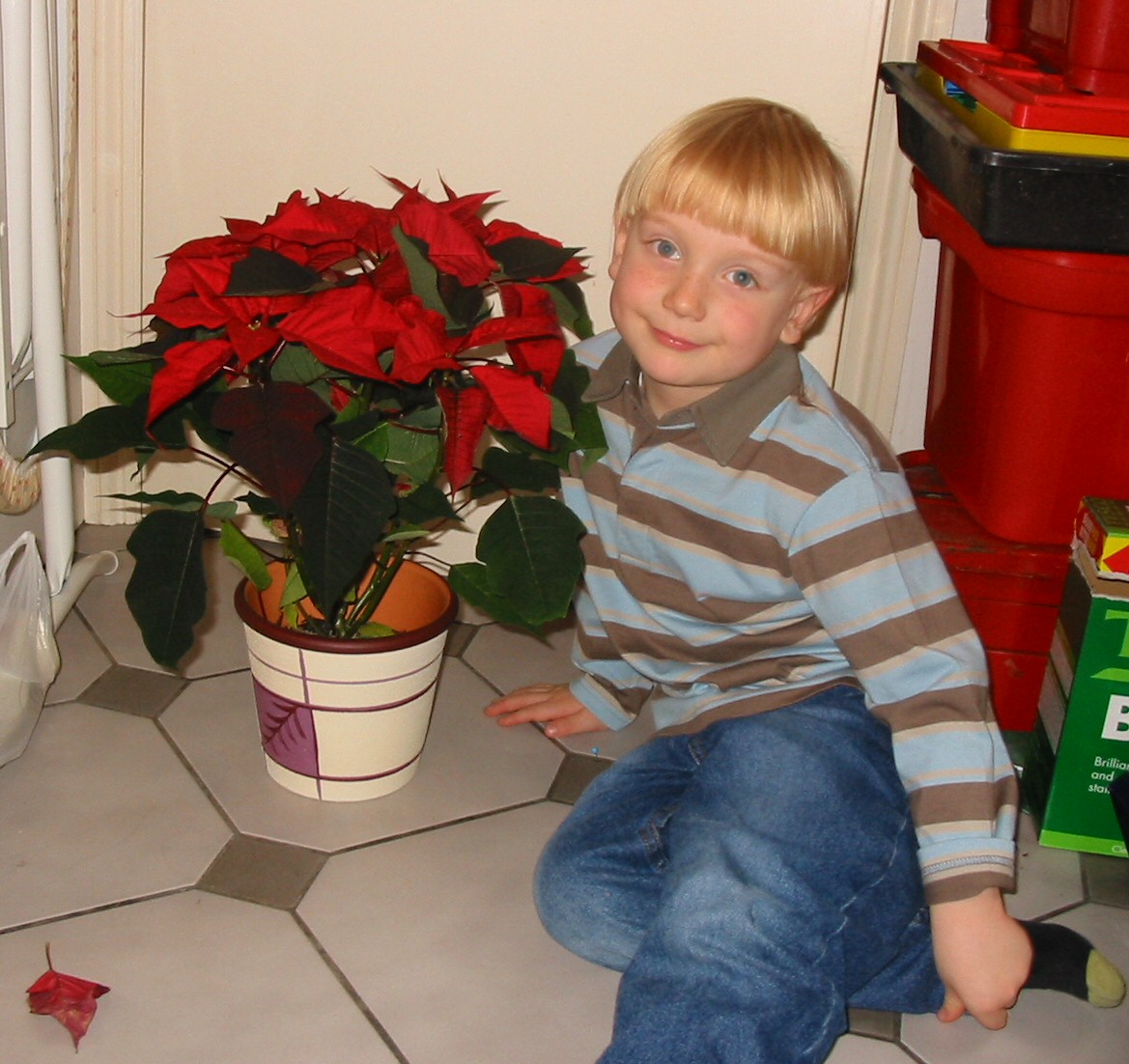
To keep the plant in bloom, maintain it at a temperature of 10 to
20 degrees C during the daylight hours and, if possible, move it
to a cooler place at night. Because root rot disease is more
prevalent at temperatures below 10 degrees C, do not put the
poinsettia in a room colder than this. Avoid exposing the plant to
hot or cold drafts, which may cause premature leaf drop.
Poinsettias can be re-flowered the following Christmas, but unless
a year long schedule of care is observed, the results usually are
not good. For such a schedule, continue normal watering of the
soil until the first of April, and then allow it to dry gradually.
Do not let it get so dry at any time that the stems shrivel.
Following the drying period, store the plant in a cool (10�C), airy location on its side or upright.
In
mid-May,
cut the stems back to about 4 inches above
the soil, and either replant in a pot 1 to 2 inches larger in
diameter or shake old soil off the roots and re pot in the same
container, using a new soil less mix. Many good commercial potting
mixes are available. Choose one that is not very finely textured.
Using soil from the garden can introduce disease to the plant.
Water the soil thoroughly after potting; wait five minutes and
water again. Then put the plant near the window that is exposed to
the most sunlight. Keep the plant at a temperature of 15 to 25�C, and water when the surface of the soil is dry to the
touch. After new growth appears, fertilize every two weeks with a
fertiliser at the rate
recommended on the label for flowering plants.
In
June, leave the plant in the pot, move it outdoors, and
place it in a lightly shaded location. Continue watering and
fertilizing the plant while it is outdoors. Pinch each stem
(remove 1 inch of terminal growth) in early July. Then, in late August, cut or pinch the new stems back,
allowing three or four leaves to remain on each shoot. After this
second pinch, bring the plant indoors and again place it near a
window with a sunny exposure. If the plant is not pinched, it will
grow too tall and be unsightly. Keep the plant at a temperature of
10 to 20�C at night and continue watering and fertilizing.
Poinsettias are short-day plants, which means they flower about 10
weeks after the daylight shortens to about 12 hours or less.
Therefore, to have the plant in full flower by Christmas, keep it
in complete darkness between 5 p.m. and 8 a.m. from early October for 8 weeks. During this period, any kind of
light exposure between 5 p.m. and 8 a.m. will delay flowering. A
closet, opaque box or opaque cloth will keep the plant in darkness
during those hours. Remember to put the plant near a sunny window
in the daytime. Continue fertilizing the plant until mid-December.
Various reports over the years have led the general public to
believe poinsettias are toxic to animals; however, this has not
been authenticated in humans. Research conducted at various
Universities and other institutions has proved the old wives' tale
that poinsettias are poisonous to be false.
E-mail: webmaster@gardenaction.co.uk
Date posted: December 05, 2011 - 09:11 pm
Message: If your neighbours can do it, so can you! Well drained and watered fertile soil plus a sunny aspect should do the trick. Yes, your trees will grow, it just takes time.
E-mail: djstude@gmail.com
Date posted: December 05, 2011 - 05:49 pm
Message: I live in Baja California on the Sea of Cortez. I just bought 2 Poinsettas that I would like to plant permantly in my garden. I saw a 12' Poinsetta tree nearby and wonder if my little 12" plants could become that big? Please advise on site selection, soil type and watering.. gracias!
E-mail: webmaster@gardenaction.co.uk
Date posted: November 27, 2011 - 02:50 pm
Message: Keep it in complete darkness from the afternoon onwards. It should have been done a month or two ago. Hopefully its redness will develop.
E-mail: emf@talk21.com
Date posted: November 27, 2011 - 11:30 am
Message: I have a poinsettia at the moment in the downstairs bathroom that I am trying to encourage to bloom again. I brought it indoors a while ago and the soil has stayed consistently moist even though I have not watered it and now the leaves are dropping off. What do I need to do?
E-mail: Private
Date posted: November 17, 2011 - 09:22 pm
Message: Plants have a temendous capacity to recover from damage. Yes, it would be smaller, but, like hair, it won't stay short for long.
E-mail: Private
Date posted: November 17, 2011 - 09:39 am
Message: Hi, I moved in to a different house this time last year and the previous owner had left a poinsettia plant!! Ive kept the plant as it looked healthy. Well the plant is absolutly huge!! Ive nevver seen one as big as it. The only problem I have with the plant is that it doesnt turn red by xmas - after reading your advice on this website I think its because I havent kept it in darkness from October onwards neith I have cut the plant back as I dont know how to do this - you say in your advice to cut them back to 4 inches above the soil - that means I would loose the size of it!!! Is it possible to still have the plant as big as it is and have it turning red year to year?? Thanks
E-mail: webmaster@gardenaction.co.uk
Date posted: November 10, 2011 - 04:21 pm
Message: Keep up the good care and hope for the best. Start your care regime next year
E-mail: elaine.pisces@gmail.com
Date posted: November 10, 2011 - 10:18 am
Message: unfortunatly I did not keep the year long schedule for the poinsettia as above,but carried on watering, its still okay with lots of leaves and growth showing. I would love to have it for christmas again with red leaves. what would you suggest,will I need to put in the dark now or repot or feed as I havent done anything to the plant.Thankyou for your help. Elaine Hill.
E-mail: Private
Date posted: October 25, 2011 - 02:49 am
Message: Read the article on this website, above,
"Make Your Poinsettia Flower Next Year?". All the information you need
E-mail: Private
Date posted: October 24, 2011 - 11:48 am
Message: My poinsettias is just over one year old and a heathy plant, but I would like the leaves to turn red for christmas. How is this done?
E-mail: Private
Date posted: September 20, 2011 - 05:58 am
Message: I have a plant and it's leaves are now green. What should I feed it to make the leaves red?
E-mail: Private
Date posted: September 06, 2011 - 05:09 am
Message: We have had a poinsetta for two years, bought as a present for Christmas. All the red leaves fell off and new green leaves formed. It is now 2' high and green and in perfect condition. How can we get it to go red again. Thank you.
E-mail: theolivercomp@talktalk.net
Date posted: September 05, 2011 - 09:24 am
Message: i had a poinsettia bought me last year the red leaves fell of over time but lovely green leave grew back but can you tell me how to get it to flower or get the leave to go red and it looks great as it is but would like to see it flower again
thank you
E-mail: lillylo@btinternet.com
Date posted: August 26, 2011 - 03:11 am
Message: Can you tell me why the my Poinsettias have no Red leaves, its a beautiful plant from Xmas and is looking well but concerned over this question?
E-mail: Private
Date posted: August 22, 2011 - 06:12 pm
Message: good evening,does the company sell cuttings
E-mail: anntkerry@msn.com
Date posted: June 06, 2011 - 05:22 am
Message: Good morning, just wanted to let you know I have 2 ponsettias, one's 4yrs old and the other is 3 yrs old. They are both in flower as I type. They have flowered every year since having them. Can't actually remember if they do flower again at Christmas though. I do have a problem with them being green leaves being mottled and I'm not sure it they are infested with little black flies. Perhaps I have over sprayed them trying to eliminate the flies. Any advice would be appreciated.
Kind Regards
Annette
E-mail: Private
Date posted: June 06, 2011 - 05:22 am
Message: Good morning, just wanted to let you know I have 2 ponsettias, one's 4yrs old and the other is 3 yrs old. They are both in flower as I type. They have flowered every year since having them. Can't actually remember if they do flower again at Christmas though. I do have a problem with them being green leaves being mottled and I'm not sure it they are infested with little black flies. Perhaps I have over sprayed them trying to eliminate the flies. Any advice would be appreciated.
Kind Regards
Annette
E-mail: Private
Date posted: May 30, 2011 - 07:34 am
Message: I have been able to keep my plant in good condition but can you tell me why the red leaves are curled in on themselves?
E-mail: Private
Date posted: May 13, 2011 - 04:55 am
Message: Thanks for doing my homework for me XD lol
E-mail: Private
Date posted: January 22, 2011 - 08:32 am
Message: My poinnsettia is a little brown and seems wilted at the tips of the branches. it still has some red leaves and new baby leaves are shooting.
in order to help it grow in healthy way shall i trim off the brown dead seeming parts of the twig?
Many thanks.