Categories
Calendars
Guides
Reviews
Archive
Gallery
Articles
Ask Our Gardening Expert
How to Grow Lavender
They keep themselves neat and tidy with a single annual pruning and they are relatively free from pests and disease. The final bonus is that they withstand drought extremely well.
Species and Varieties
There are in excess of 50 species of
Lavender plants which come in a wide variety of sizes, hardiness,
flowers and foliage. The main varieties widely available are discussed
below.
English Lavender (Lavandula.angustifolia)
The flowers appear
from late Spring right through to late summer. Lavandula.angustifolia
is often incorrectly referred to as Lavandula.officinalis or vera.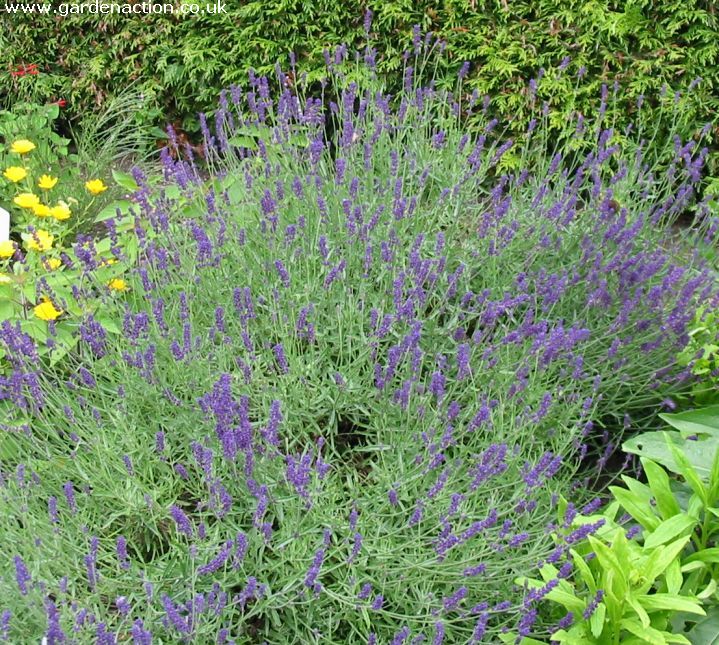
Lavandula.angustifolia
Size of height and spread is normally within the range 45cm to 75cm
(1�ft to 2�ft). Given time these lavenders form mounds and this looks
impressive when lots of tem are planted together.
English lavender makes an excellent low level hedge. Maintenance is simple, the massed flowers are truly glorious and the scent is spectacular. Often overlooked is the fact that lavender attracts a wide variety of insects.
If you want to buy lavender plants online from our recommended suppliers then click here.
Lavandin or Dutch Lavender (Lavandula.x intermedia)
The stems of Lavandins are longer than English Lavender and when
mature these plants have a height and spread of about 90cm (3ft). This
makes them ideal as low hedging plants.
Lavandula.stoechas
These lavenders are not so easy to grow in temperate climates such as the UK
because they do not survive our wet winters very well. They produce dark
purple flowers up to 4cm (1�in) long. Impressive but only suitable for
very free draining soils. Best suited to being a specimen plant in a
pot or tub where soil conditions can be closely controlled.
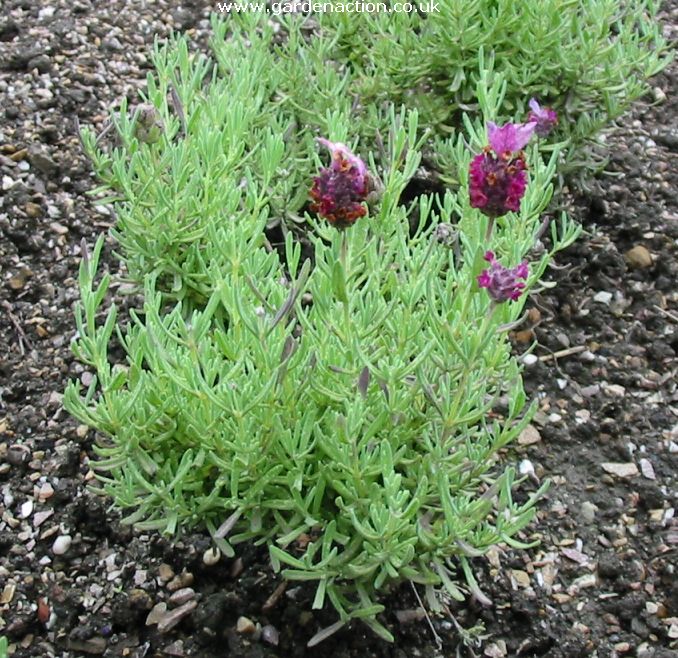
Lavandula.stoechas Kew Red
Lavandula.dentata
These lavenders are half hardy. They are identified by the leaves
which have deep "teeth" up their entire length. The flowers (bracts in
truth) are unusually shaped and appear on the ends of very long stems.
Name: helplessnks
E-mail: Private
Date posted: October 01, 2011 - 03:22 pm
Message: I live in Eastern KS. I have been ill for the last 5 yrs, but during last 3yrs I've worked steadily to improve the gardens� allure. I'm dealing with poor, clay soil so each time I transplant a big clay spot is replaced with garden soil, and give the new plant roots some care too. Following, the spot is mulched with peat...blah, blah. Blue Lavender, where should I plant it? I place plants that say full sun in the sun but they wind up dying even with daily care. I have an area on the N side, receiving a lot of in-direct light. My Coleus thrived there. Two big windows are right there so ready to receive the fragrance. Please someone with our strange KS summers (they'll be by the foundation-no worries winters) I just want a gardener to give me a 'green' thumbs-up.
Big Q; I received my stock (mail order) and the Blue Lavender looks rather sad. Since Lavender is a perennial, and the roots look ok, will it be strong enough to transplant with care to bloom in 2012�right? I hope so because that is what I did. Well, it is great that perennials can always be moved! Thanks.
Name: C Mckeegan
E-mail: Private
Date posted: June 21, 2011 - 04:02 am
Message: When should I pick lavendar to dry it,
for bags for church charity
Name: Jane
E-mail: Private
Date posted: January 24, 2011 - 01:01 pm
Message: Hi, I have lavander in a pot that I had outside over the summer. When the purple flowers died, I cut them off and brought the plant inside and havent watered it at all. Im not sure if I should cut the stems right back, or leave them and or put the plant outside, to ensure it flowers again next year. Can you help? thank you.
Name: Ray Maisey
E-mail: ray@rabbithutchprinters.com
Date posted: November 23, 2010 - 06:27 am
Message: I have a couple of tubs of french lavendar I bought in summer,they have now finished flowering and I have trimmed off the old flowers. Are they frost hardy of do I need to put them in the shed or garage - Regards Ray Maisey
Name: Susan Connoly
E-mail: susanconnolly65@yahoo.co.uk
Date posted: August 28, 2010 - 03:33 pm
Message: My lavender is beautiful, very prolific, with lots of bloom. But, underneath it is extremely woody. When pruning time arrives I am going to be left with these woody branches,which no doubt will bear fruit next year.
I hate to dig them up, but I feel it is time they moved out for younger brothers or sisters to take their place.
Today I have visited the nursery and purchased five new pots of lavender. Should I bite the bullet and dig my friends up. What is the alternative?