Categories
Calendars
Guides
Reviews
Archive
Gallery
Articles
Ask Our Gardening Expert
Hydrangea Care
The flowers
normally consist of a mass of fertile flowers surrounded by
infertile flowers which give the hydrangea its large flower heads.
Some varieties however have almost all sterile flowers. Hydrangea arborescens and quercifolia are natives of North
America, Hydrangea serratifolia is native to South America. The
remainder of hydrangeas are natives East Asia. Recommended for the amateur and experienced gardener. Key
Hydrangea Facts
Botanical Name
Hydrangea
Common Name
Lacecap, Mop head, Oak leaf
Type
Deciduous
shrub or small tree; summer flowering.
Size
Position
Full
sun or partial shade depending on variety.
Soil
Light and well-drained
Hardy
Yes but depends on the variety
Flower
Blue, pink or white
Foliage
Mid green
Scent
No
Season of
Propagate
Greenwood cuttings when flowers are dying or by layering,
Hydrangeas
which are either blue or pink are dependant on the level of acid
in the soil for their colour. The deepest blue flowers are grown
on acid soils whereas the pink flowers come from neutral to
alkaline soil. Name: alan crook Name: jim@GardenAction Name: J. Tollevrey Name: Cecilia Lau Name: lynn Name: Ed Pennance Name: Jill Name: Michelle Name: B Pryke Name: ian Name: DARINA BEESLEY Name: irene Name: frederick hobbs Name: Ann Malony Name: Michelle Name: sreema Name: ciaran morgan Name: Meryl Johnson Name: George Benzie Name: Patricia Armstrong 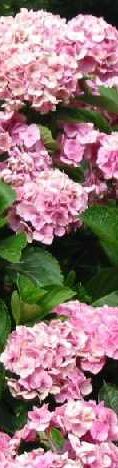 Hydrangeas are deciduous shrubs or
small trees. They are grown for their beautiful domed or flattened
flowers which appear in mid-summer for a month.
Hydrangeas are deciduous shrubs or
small trees. They are grown for their beautiful domed or flattened
flowers which appear in mid-summer for a month.
(after 5 years)
Varies considerably depending on the variety
Interest
Summer.
E-mail: alan.crook@live.co.uk
Date posted: November 13, 2011 - 07:56 am
Message: i have a hydrangea the flower heads are now brown, do i have to cut them off or leave them ?
E-mail: Private
Date posted: November 13, 2011 - 12:36 am
Message: Hydrangea flower on previous season's growth. Perhaps it was pruned off?
E-mail: Private
Date posted: November 11, 2011 - 07:31 am
Message: I bought a Hydrangea last year in full bloom but have had no flowers on it this year. Can you tell me why this might be. How is best to store for winter.
Any advice would be much appreciated.
Thank you
E-mail: gardeninbloom@hotmail.com
Date posted: October 03, 2011 - 01:26 pm
Message: Marigold likes liquid seaweed fertilizer
E-mail: Private
Date posted: September 24, 2011 - 12:20 pm
Message: I have been bought a hydrangea with white flowers. It is currently indoors.
Should I leave it indoors now until spring and how do I make sure flowers stay white?
E-mail: Private
Date posted: August 31, 2011 - 05:31 am
Message: Last year I bought and planted 3 Mophead Hydrangeas (in flower at the time). When the flowers were dead and gone brown I cut the plants down nearly to the ground. They have now doubled in size and look very healthy but..... they have no flowers! I realise now that I shouldn't have cut them down but my question is :- if I leave them alone, will they flower next year?
E-mail: Private
Date posted: August 16, 2011 - 04:18 pm
Message: My hydrangea has now produced any flowers this year but as gone very tall and full of good healthy leaves!!!!
E-mail: Private
Date posted: August 15, 2011 - 03:51 pm
Message: Hi there,
I have always wanted a blue hydrangea, I finally got one for my birthday and was so happy! But now it's dying! i'm normally very good with plants, but I dont know what I'm doing wrong. I have now put the plant outside but the flowers died, the soil is not to wet and not dry, I'm freaking out as my friend gave me this plant and now its dying :-(O please help me
E-mail: varvaroo@hotmail.co.uk
Date posted: August 15, 2011 - 05:14 am
Message: My Hydrangea hasn't flowered for the last 3 years.It looks healthy but only leaves.desperate for help.
E-mail: Private
Date posted: August 06, 2011 - 03:11 am
Message: Hydrangea macrophylla growing against wall of house in a sunny site. its about 20 years old. The lower leaves have turned partially white - similar to variegated leaf. The upper leaves are healthy green.Similar problem on Roses and Clematis. Whats causing this whitening of leaves?
E-mail: darinabeesley@yahoo.com
Date posted: July 10, 2011 - 12:17 pm
Message: My white hydrangea black/redish on the outside of the leaves and some of the same on the inner leaf. What is the problem
E-mail: stewartshort@btinternet.com
Date posted: June 28, 2011 - 10:41 am
Message: macrophylla has stopped flowering
need help
E-mail: frederick.hobbs@btinternet.com
Date posted: June 15, 2011 - 05:20 am
Message: my lacecap has not flowered for the
second year running the leaves look an
odd reddisb brown colour.The plantlooks healthy other wise
E-mail: Private
Date posted: May 30, 2011 - 09:53 am
Message: Have been growing white hydrangeas for 5 years in my garden; these were previously in my parents' garden for some 30 years. This year they are being attacked by micro sized brownish bugs which travel up the veins of leaves. We also have blue and pink hydrangeas but these seem to be immune from the bugs.
E-mail: Private
Date posted: October 05, 2010 - 04:23 am
Message: Why have my hydrangeas gone a funny colour green? I know the summer is over but they started to go this colour shortly after planting them in my garden. My soil is quite clay based
E-mail: Private
Date posted: October 01, 2010 - 02:01 am
Message: i want to know about fertilizers of hydrengia to bloom
E-mail: ciaranmorgan1@sky.com
Date posted: September 30, 2010 - 12:45 pm
Message: i have just bought 3 hydrangea plants from b&q in pots which are 9 inches diameter. i am going to plant them out in the garden, but wondered is it a good idea to throw some of my hens droppings in the bottom of the hole before placing the plant?
E-mail: johnsons40@hotmail.com
Date posted: September 15, 2010 - 03:18 am
Message: We have two hydrangea bushes over 30 years old. Over the past few years white 'eggs' have appeared on the stems and leaves but no one seems to know what these eggs are. Can anyone help please?
E-mail: george.benzie@talktalk.net
Date posted: September 08, 2010 - 07:16 am
Message: When should I cut back, and to what height, tubs I bought in the Spring and now leaves browing ?
E-mail: stararnstrong50@fsmail.net
Date posted: August 07, 2010 - 07:19 am
Message: I have grown hydrangea in lg pots for years. this year there are rust spots in flower heads. Is this a disease. Thanks for any help you have. Pat