Categories
Calendars
Guides
Reviews
Archive
Gallery
Articles
Ask Our Gardening Expert

Harvesting
Your Gooseberries In order to encourage the best berries, pick about 10% of the fruit
in
mid-May
time when they are pea-sized, these can be used for
cooking. This will encourage the remaining fruits to become larger. When the gooseberries look ready for harvest in
July
time, first pick
those fruits which are shaded at the bottom and in the middle of
the bush - these will be the first to stop improving. Leave the
fruits on the outer edges of the bush to be picked a week or so later.
Pests and Diseases Click
here for more details on identifying and treating Gooseberry
Sawfly caterpillars. The biggest pest is birds, sparrows in particular. Coloured cotton
wound round the plant at strategic places will go some way to
prevent the birds getting at the fruit. Most garden centres have
bird-repellant sprays - ask at your garden centre which is best for your area. Which Variety INVICTA HINNOMAKI RED
Name: Missy Name: Val Hannah Name: Jeff Name: Linda Name: Tony Green Name: kerry everall
WHINHAM'S INDUSTRY LEVELLER
Growing Gooseberry Bushes
(continued - page 3)
Most varieties of Gooseberry bush produce both cooking and
eating gooseberries - those for cooking being harvested earlier than those for eating.
Gooseberry bushes grown in the UK are remarkably free from pests
and diseases. They are on occasions attacked by Gooseberry
Sawfly caterpillars
which are capable of stripping the plant of all foliage. A soon
as foliage damage is noticed. examine the plant for caterpillars
and pick them off by hand. If the numbers of caterpillars are
large, spray with derris (available at almost all garden centres).
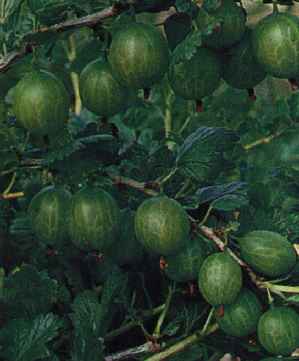 Click
on the picture for a larger version. A very compact plant which
is ideally suited to growing as a standard in or out of a
container - see the next page (or
click here) for details on how to grow gooseberry bushes in
containers. Produces masses of fruits in
July
to
August
which
are extremely tasty. Definitely one for the small garden. A
GardenAction top recommendation.
Click here to buy online from our recommended suppliers.
Click
on the picture for a larger version. A very compact plant which
is ideally suited to growing as a standard in or out of a
container - see the next page (or
click here) for details on how to grow gooseberry bushes in
containers. Produces masses of fruits in
July
to
August
which
are extremely tasty. Definitely one for the small garden. A
GardenAction top recommendation.
Click here to buy online from our recommended suppliers.
E-mail: Private
Date posted: November 10, 2011 - 03:41 pm
Message: I grew up in West Virginia and have many fond memories of our gooseberry bushes. I now live in New Orleans, is there any gooseberry (variety) that would grow here?
E-mail: Private
Date posted: July 01, 2011 - 10:47 pm
Message: My gooseberry bush started out great this year and then bugs and little green worms got to it. Can it be saved? It is very old. What should I do at this point? It is really my sisters,is there a good time to transplant it to her house?Thank you.
E-mail: jmjp@sky.com
Date posted: May 18, 2011 - 01:24 am
Message: I have a gooseberry bush which is growing in a pot. It is doing really well but has not produced any fruit. Earlier in the year it did have some flowers,only about half a dozen but these didn't come to anything. Any advice would be welcome
E-mail: flanmail@comcast.net
Date posted: September 17, 2010 - 05:06 pm
Message: I've planted my gooseberry bush 5 years ago and it's doing well, except I've never had any fruit on it. (I haven't seen any birds near it). Do they have to mature a few years before producing fruit?
E-mail: tony @tony-green.com
Date posted: August 09, 2010 - 08:17 am
Message: Advice required please,
I live in Spain and have nearly fifty what I believe to be Kerry Everall Gooseberry bushes, the crop has been exceptionally good this year but four of the bushes have died back, I can see no reason why this has happened, as te rest of the bushes are strong and healthy, have you any opinions or advice to the problem
E-mail: kerry-wery@hotmail.co.uk
Date posted: August 06, 2010 - 05:31 am
Message: how do i know when my gooseberrys are ready?.I brought them in april or may this year.
kerry.
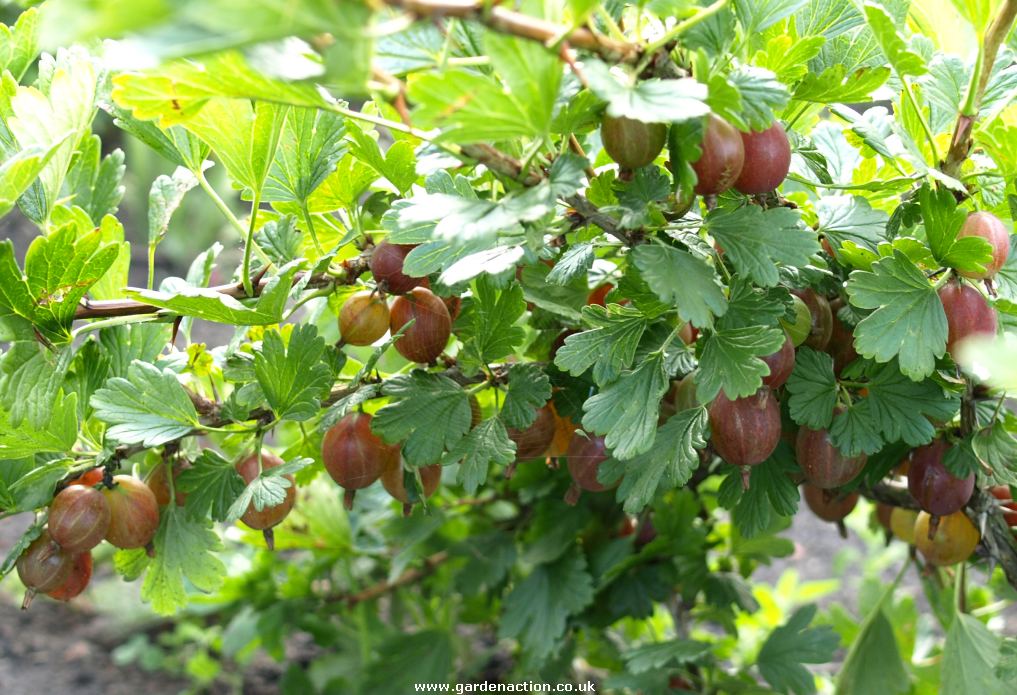 This is our most recommended variety of
gooseberry. It produces shed loads of fruit (click the
picture to see more clearly) and has great disease
resistance.
This is our most recommended variety of
gooseberry. It produces shed loads of fruit (click the
picture to see more clearly) and has great disease
resistance.
If you never can quite remember when to harvest your
gooseberries then buy this one. When the fruits turn red
they are ready to pick, it's that simple. They retain the
red colour during cooking - they taste and look superb. Purchase this variety
online by clicking here.
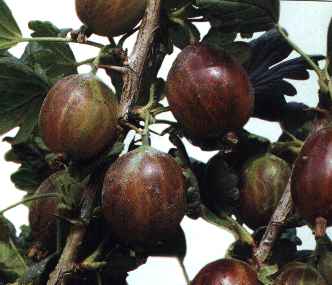 Click
on the picture for a larger version. A red-fruited variety which
is also suited to the small garden and container growing. Does
well in partial shade and will even fruit well when planted under a tree. Good for a north facing-wall.
Click
on the picture for a larger version. A red-fruited variety which
is also suited to the small garden and container growing. Does
well in partial shade and will even fruit well when planted under a tree. Good for a north facing-wall.
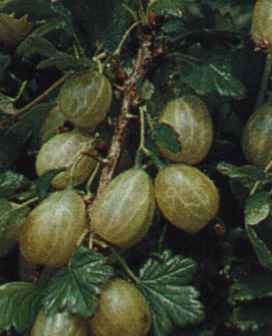 Click
on the picture for a larger version. This variety is rightly
popular, producing some of the tastiest fruits of all
gooseberries. The fruits are produced around
July, and can be
used for for cooking or immediate eating - traditional oval
gooseberry shape, with yellow and green colouring. If you choose
this one, get the soil preparation correct and it will do very well.
Click
on the picture for a larger version. This variety is rightly
popular, producing some of the tastiest fruits of all
gooseberries. The fruits are produced around
July, and can be
used for for cooking or immediate eating - traditional oval
gooseberry shape, with yellow and green colouring. If you choose
this one, get the soil preparation correct and it will do very well.
Name: Missy
E-mail: Private
Date posted: November 10, 2011 - 03:41 pm
Message: I grew up in West Virginia and have many fond memories of our gooseberry bushes. I now live in New Orleans, is there any gooseberry (variety) that would grow here?
Name: Val Hannah
E-mail: Private
Date posted: July 01, 2011 - 10:47 pm
Message: My gooseberry bush started out great this year and then bugs and little green worms got to it. Can it be saved? It is very old. What should I do at this point? It is really my sisters,is there a good time to transplant it to her house?Thank you.
Name: Jeff
E-mail: jmjp@sky.com
Date posted: May 18, 2011 - 01:24 am
Message: I have a gooseberry bush which is growing in a pot. It is doing really well but has not produced any fruit. Earlier in the year it did have some flowers,only about half a dozen but these didn't come to anything. Any advice would be welcome
Name: Linda
E-mail: flanmail@comcast.net
Date posted: September 17, 2010 - 05:06 pm
Message: I've planted my gooseberry bush 5 years ago and it's doing well, except I've never had any fruit on it. (I haven't seen any birds near it). Do they have to mature a few years before producing fruit?
Name: Tony Green
E-mail: tony @tony-green.com
Date posted: August 09, 2010 - 08:17 am
Message: Advice required please,
I live in Spain and have nearly fifty what I believe to be Kerry Everall Gooseberry bushes, the crop has been exceptionally good this year but four of the bushes have died back, I can see no reason why this has happened, as te rest of the bushes are strong and healthy, have you any opinions or advice to the problem
Name: kerry everall
E-mail: kerry-wery@hotmail.co.uk
Date posted: August 06, 2010 - 05:31 am
Message: how do i know when my gooseberrys are ready?.I brought them in april or may this year.
kerry.