Categories
Calendars
Guides
Reviews
Archive
Gallery
Articles
Ask Our Gardening Expert
How to Care for Strawberries
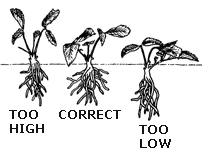
It is important to plant strawberry plants to the correct depth - too low in the ground and the growing crown may rot, too high and the roots may dry out.
Use the diagram on the left as a guide and also see the real picture below it.
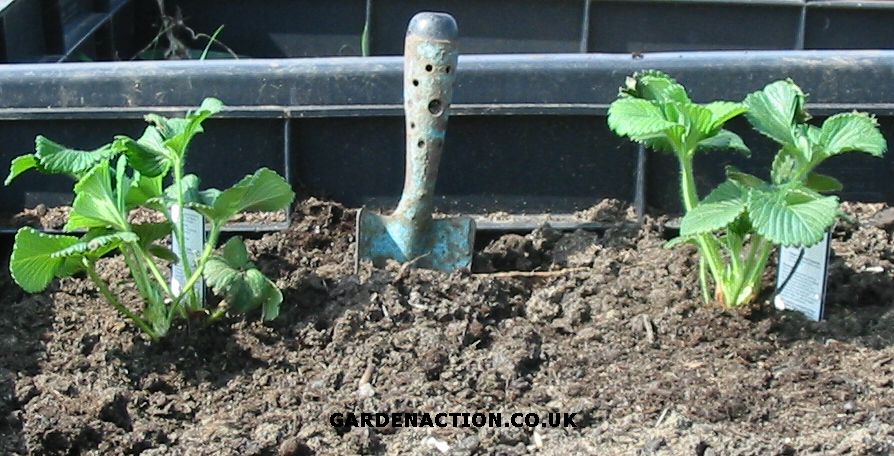
The left hand plant in the diagram above is too high and the roots may dry out. The right hand plant in the diagram above is too low and the roots may rot, the middle plant is correct (as is the real picture to the right).
The plants should be planted to the same depth as they have grown in their pots.
Care of Strawberries
Strawberries need lots of water until they are well established but don't water-log them. When established (around May), they should be OK without additional water. But when the fruits start to swell, begin to water again. Summer fruiting strawberries planted in spring and perpetual strawberries should have their first blooms pinched off to enable a good root system to establish. Strawberries planted in September can be left to flower and fruit in their first summer.
Strawberries prefer a well-dug, free draining soil. If the soil is water-logged the plants will quickly attract a wide variety of mould disease. Feeding strawberries is not needed if you spread a layer of well-rotted compost around the plants in early spring. This will also help retain moisture without causing water logging.
If you want to feed the plants in the spring, use a weak solution of tomato feed which is high in potassium. Feeding with a nitrogen rich feed will only encourage leaf growth at the expense of fruit growth. The best time to feed the plants is when you see the fruits forming in late spring.
Because strawberries produce their fruit so quickly, it is not necessary to feed them - this makes it all the more important that the soil is prepared as described above.
In May, the plant will produce runners which have 'nodes' along them - these nodes are the beginning of new strawberry plants. The runners should be removed because they will sap the strength from the plant resulting in less fruit.
Where the plants are being grown under cloches, remember to open them wide during the middle part of the day so that insects can reach the flowers and pollinate them.
Care for Strawberries - Protecting the Fruit
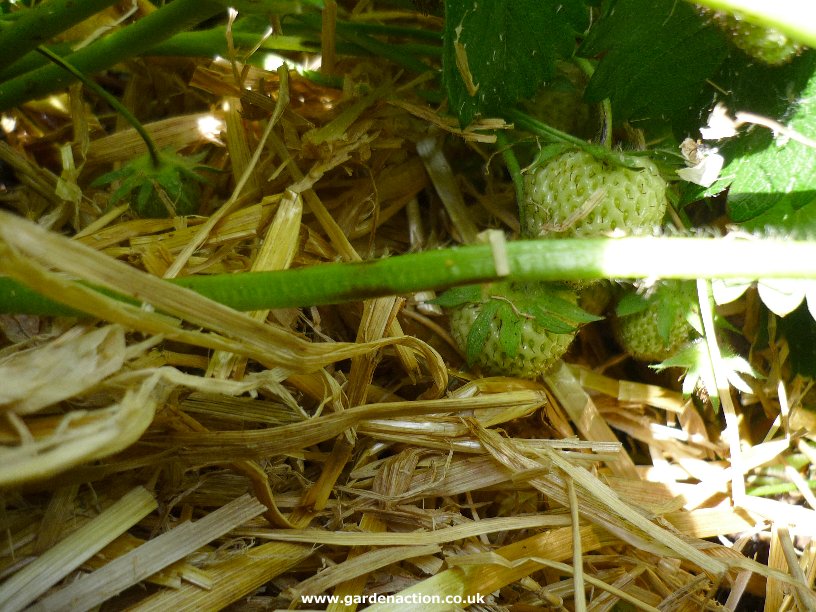
As the fruit begins to develop, their weight will cause them to lay on the ground. Before this happens (but no earlier than necessary), cover the soil around the plants with either straw or black plastic. Where plastic is used, it can be kept in place with stones - small holes should be made in the plastic to allow drainage and stop water gathering on it. The plastic or straw will prevent the fruits from lying directly on the soil which will rot them.
If you have a bird population in your garden, the plants should be protected
(when the fruits begin to swell) with light weight plastic netting. This should be held
clear of the plants by tying it to short wooden posts and securing the netting to them.
Wire mesh can also be used, held in place by canes at either corner.
 A more permanent and effective solution to bird damage of many fruits is a fruit
cage.
Click here to see a range of excellent quality and good
value walk-in, heavy duty steel fruit cages.
A more permanent and effective solution to bird damage of many fruits is a fruit
cage.
Click here to see a range of excellent quality and good
value walk-in, heavy duty steel fruit cages.
Other walk-in fruit cages are available by clicking on the
descriptions below:
Decorative Steel Fruit Cage
Aluminium Fruit Cage, by far the best on the market in it's class!
Timber Fruit Cage, for a more rugged natural look
Smaller fruit cages are also available below:
Steel Vegetable and Strawberry Cage, stands 1.2m high above ground
Steel Freestanding Veg and Strawberry Cage, easily moved around
Aluminium Vegetable Cage - the cost effective option
Growing Strawberries in Containers
Strawberries can be grown in all sorts of containers and their needs are the same. We recommend the specially designed strawberry planters with rings of neat holes - there is no need for the fancy ones, a basic one will do the job well.
First, prepare a layer of drainage materials (hardcore, broken bricks etc.) covering the base of the container for an 2.5 cm (1in) high. Cover the drainage layer with potting compost to the level of the lowest ring of holes.
For all but the smaller containers, it is vital to provide a central drainage core as well. Either make a wire mesh tube 10cm (4in) in diameter, and 10cm (4in) shorter than the height of the container; place it into the middle of the container and fill with drainage material. Alternatively use a plastic tube of the same diameter and height, place it in the container, fill with drainage material and remove the plastic tube when it is surrounded by potting compost.
Place the plants through the lowest level of rings and add more compost up to the next level of rings - continue until reaching the top. It is a good idea to gently firm the compost down as you go along, and water the compost at each level of rings to ensure it is fully moist.
Recommended Strawberry Varieties
Recommending varieties of strawberries is difficult because so much depends on personal taste. However you will not be disappointed if you choose one of the varieties listed below. Click here if you want to buy your strawberry runners online now.
CAMBRIDGE FAVOURITE (summer fruiting)
The best example of how a summer strawberry should be. Lovely red
medium sized fruits with lots of taste. This variety has been a gardener's
favourite for generations.
MAE (summer fruiting)
Brand new in 2003 this variety produces very early fruits. Use poly-tunnels
or cloches to protect the plants up to mid June (
click
here to buy poly-tunnels / cloches online now) and this variety
will provide you with strawberries as early as mid May. The fruits are
large, firm and tasty.
FLAMENCO (perpetual)
Large tasty red fruit produced over a long season starting in June. Very
good disease resistance.
Strawberry Diseases and Pests
The major pests and diseases of strawberries are aphids, red spider mite, slugs, powdery mildew and botryitis. Click here to go to the GardenAction Pests and Disease Control Center which has a section dedicated to strawberry pests and diseases.
How to Propagate Strawberries
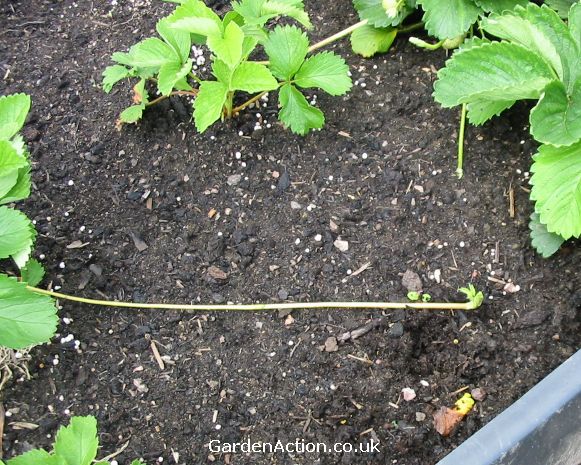 Propagating strawberries is simplicity itself. Look out for
runners as in the picture on the left (click picture to enlarge it).
Propagating strawberries is simplicity itself. Look out for
runners as in the picture on the left (click picture to enlarge it).
Let the plantlet that forms at the tip of the runner root of its own accord. Then about three weeks after it has rooted, cut the runner, dig up the soil around the rooted plantlet and put it in a pot of normal potting compost.
Keep the potted strawberry plant in a light position, keep the soil moist and feed with a nitrogen based liquid fertiliser every two weeks. If the plants outgrow the pot (the roots start popping out of the base of the pot) then pot into a slightly larger pot.
Around September time plant the potted strawberry plant into its final position.
Name: jim@GardenAction
E-mail: webmaster@gardenaction.co.uk
Date posted: October 17, 2011 - 09:45 pm
Message: In May, the plant will produce runners which have 'nodes' along them - these nodes are the beginning of new strawberry plants. The runners should be removed because they will sap the strength from the plant resulting in less fruit. Louisiana is mild. Plants are safely left uncovered through winter.
Name: Mike
E-mail: Private
Date posted: October 17, 2011 - 08:36 pm
Message: I planted 24 strawberry plants in a 4' x 8' bed. I really didn't make enough berries to brag on. Now the plants have quit making berries and have produced runners that have multiplied into over a hundred plants. What do I need to do now? Can I save all these plants for the surface area I have or just save a few? I live in south Louisiana where strawberries normally do well. Do I need to remove some of the plants? Do I need to cover them for the winter with clear sheeting or just top the plants and cover them with either hay or mulch? Any help would be greatly appreciated. Mike
Name: Maggie
E-mail: Private
Date posted: October 11, 2011 - 10:25 am
Message: Similar to Ray's comment below, I have no runners on my strawberry plants this year. I have grown strawberries in the past & last year started again with Everbearer. Last year there were plenty of runners but this year the same container grown plants have produced none. Could it be due to the peculiar weather conditions this year? I live in the South West of England.
Name: jim
E-mail: Private
Date posted: September 28, 2011 - 07:54 am
Message: what do i do with my strawbeery plants during winter
Name: Ray Coulson
E-mail: raycoulson734@btinternet.com
Date posted: September 10, 2011 - 06:45 am
Message: For many years I have propagated strawberries from existing plants and have given away when I have too many.
This year I have had no runners from any of my strawberries from those grown in the greenhouse to those outside in strawberry pots.
Can you please advise why?
Name: pauline clarke
E-mail: clarkesvill@ntlworld.com
Date posted: August 31, 2011 - 10:54 am
Message: hello can you please help me this is my first time at gardening i,m ok with flower,s but i dont know about fruit i have a strawberrie plant ( one ) and it,s now has new shout,s coming from the mother plant i,v put them in pot,s and there growing nicely but it,s now the end of aug and i dont know what to do with my plant so can some one help me please
Name: iain garrett
E-mail: iaingarrett@hotmail.co.uk
Date posted: August 19, 2011 - 07:06 am
Message: myb strawberries have completely finished what do i do with the area where the strawberry plants are and the plants themselves
Name: carol
E-mail: itctt@aol.com
Date posted: August 08, 2011 - 10:48 pm
Message: What do I do with my strawberry pot in the winter? do I bring it inside and continue to water the plants, or do they come to life again after the winter months?
Name: mike
E-mail: robinmike@hotmail.co.uk
Date posted: July 27, 2011 - 07:55 am
Message: i grew strawberry runners last year,but the plants this year are costanly sending runners but no flowers and fruit,is thewre a reason please,Its not the first time this has happened with me,is it the variety,maybe hybreds cannot propogate,im at a loss
Name: adrian oconnor
E-mail: adrian_oconnor@blueyonder.co.uk
Date posted: July 19, 2011 - 06:25 am
Message: For the second year running I have wonderfully lush looking strawberry plants. This year I am growing them in gro-bags, last year in the soil. Problem is that this year, as last year, my wonderfully healthy looking plants do not seem to have even a single berry growing on them! The last time I actually ate a strawberry off one of my plants, or indeed saw one, was the summer before last. These are new plants this year.
Any suggestions as to what is going wrong?
best regards
Adrian O'Connor
Name: adrian oconnor
E-mail: adrian_oconnor@blueyonder.co.uk
Date posted: July 19, 2011 - 06:19 am
Message: For the second year running I have wonderfully lush looking strawberry plants. This year I am growing them in gro-bags, last year in the soil. Problem is that this year, as last year, my wonderfully healthy looking plants do not seem to have even a single berry growing on them! The last time I actually ate a strawberry off one of my plants, or indeed saw one, was the summer before last. These are new plants this year.
Any suggestions as to what is going wrong?
best regards
Adrian O'Connor
Name: dave
E-mail: davidj175@aol.com
Date posted: June 27, 2011 - 03:34 pm
Message: strawberry plants should be renewed every 3 year. what i tend to do is keep the runners after the second year from the strawberry plant, then throw the old strawberry plants on the compost heep.
Name: Brenda Rutherford
E-mail: Private
Date posted: June 07, 2011 - 09:39 am
Message: i have had my strawberries for about five years and they do not seem to be producing like they were. Are the plants old and do i need to replace them or is it because we have not had enough rain?
Name: jahanshah
E-mail: jahahnshah_aliyan@yahoo.com
Date posted: June 06, 2011 - 05:28 am
Message: I am in Iran . I want to know that , how much the cost of planting of strawberry in hectare
Name: abdullah al fahad
E-mail: Private
Date posted: May 28, 2011 - 03:44 am
Message: i want to learn the skills of planting strawberry.
Name: muzeeb
E-mail: ahmadtabrez83@yahoo.com
Date posted: December 26, 2010 - 01:58 am
Message: want to start urgently strawberry commercial farming in u.p india please say me date & month fore grow seeds in the farm
Name: Cathy
E-mail: Thomson
Date posted: December 24, 2010 - 04:08 pm
Message: Do you prune strawberry plants?
Name: Lilian
E-mail: Lilian.Geturo@gmail.com
Date posted: December 21, 2010 - 02:20 am
Message: Want to start strawberry commercial planting next year. I am in Kenya, Africa. Would love to hear from someone on the challenges of commercial farming of the strawberries.
Thanks
Name: michael
E-mail: virtualtdigtech75@yahoo.com
Date posted: December 19, 2010 - 05:45 am
Message: am planning to start strawberry commercial farming is it ok if it can be done on green house please assist. thank you.
Name: sharibdol
E-mail: batmanbestari206@hotmail.com
Date posted: December 03, 2010 - 11:21 pm
Message: i want to learn the skills of strawberry planting