Categories
Calendars
Guides
Reviews
Archive
Gallery
Articles
Ask Our Gardening Expert
Beetroot sowing and seed, beetroot care and cultivation - page 2
Soil and Site for Beetroot
Beetroot's ideal soil is medium to light, although a heavy but well-dug soil will
also be OK. What it definitely does not like is a soil which has
recently been manured - this will cause the roots to be mis-shapen. The
soil should be neutral or slightly alkaline
('pH' 6.5 to 7.5) although it is tolerant of most normal conditions.
Either use a site which was well-prepared for a previous crop (such as peas,
beans, onions or celery) or dig the soil well the previous autumn and
let the winter frost break it up even more.
When digging, remove as many
stones as possible - the roots like to grow without restriction.
Beetroot can also be grown in raised beds with other vegetables. Click here to go to our page on raised beds for more information.
Sowing BeetrootBeetroot should be sown when the danger of hard frost has passed, mid-April is about right in . In order to avoid glut, plant in small batches up until mid-July. If you want beetroot crops three or four weeks earlier, use a small poly-tunnel or cloche. Simply place the poly-tunnel in position two weeks before sowing (to warm up the soil), then sow the seed three or four weeks earlier than normal. Click here to buy a poly-tunnel or cloche from GardenAction's recommended online supplier.
Warrior
- globe type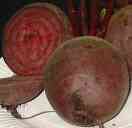
With a trowel, scoop out a line in the soil about 2.5cm (1in) deep - where more than one line is to be planted, space each line about 30cm (1ft) apart. Space the seeds in the lines 5cm (2in) apart and cover with soil. Water if the soil is dry.
The seedlings will appear in about 15 days, depending on the weather. Each seed planted will result in a cluster of three or four seedlings. Remove the weakest seedlings, leaving only the strongest for each seed sown. When the seedlings reach 5cm (2in) high, thin them to their final distance apart. This is 10cm (4in) apart for round or globe varieties and 15cm (6in) apart for long varieties.
Care of Beetroot
The young seedlings may well attract the unwanted attention of birds. If your area
is troubled, it is best to cover them in netting for a while or whatever
is your best method. Clear plastic plastic bottles with the top and
bottom cut off and placed over the seedlings when they emerge is a good
method if you plant only a few seeds.
Beetroot will definitely appreciate a thorough watering if the conditions become dry. This will encourage them to grow quickly and the roots will be more tender and tasty. Luckily enough, little weeding should be required because the foliage of beetroot is dense enough to keep most weeds at bay.
One tip is to apply a light application of common or rock salt around the plants (avoid the foliage) when the seedlings are established. Beetroot does best near the sea and applying salt mimics these conditions.
Name: Hannah
E-mail: Private
Date posted: July 18, 2011 - 05:47 am
Message: Thank you John Whitely. I am suffering badly with my beetroot this year. Leaves are yellowing and dying when still young. Any bulbs stop growing. Could this be leaf miner. Seems to spread from one patch to another. I use Boltardy. When sowing your carrots and beetroot, how high were your potatoe tops? Would the beetroot grow without light?
Name: Hannah
E-mail: Private
Date posted: July 18, 2011 - 05:33 am
Message: Thank you John Whitely. I am suffering badly with my beetroot this year. Leaves are yellowing and dying when still young. Any bulbs stop growing. Could this be leaf miner. Seems to spread from one patch to another. I use Boltardy. When sowing your carrots and beetroot, how high were your potatoe tops? Would the beetroot grow without light?
Name: Doreen
E-mail: dmukiza@gmail.com
Date posted: June 08, 2011 - 05:08 am
Message: Ilike this. i wouldb like to get as many details concerning beetroot farming.
Name: COLIN TIMOTHY
E-mail: dark_vader_angel@yahoo.com
Date posted: November 17, 2010 - 12:54 pm
Message: i live in trinidad & tobago west indies i have a little home garden which i plant sweetpeppers,lettice,pementoes,tomatoes, i would luv 2 try beetroot but down here is mostly sun and rain how do i go about trying 2 plant it would grow down here in my country seeing that it is mostly sun and rain.
Name: john whiteley
E-mail: Private
Date posted: August 18, 2010 - 08:08 am
Message: Put some seeds of beetroot and carrots that I found in my shed 2 weeks ago thought I will try them nothing to lose just put them in between my spuds found that the foilage from the spuds protects the carrots from carrot fly and the beetroot is coming on a treat just thined them out let you know what the crops are like.